Saturday, 22 March 2014


Wednesday, 16 October 2013
Of slavery in human
society ants and the defense against it
"Slavery is
founded in the selfishness of man's nature - opposition to it, is his love of
justice.”
-Abraham Lincoln
If you had
thought slavery is a concept only in humans, you are mistaken. Slavery is seen even
in ants!*
Before you
find out more about the ant slavery, you need to know the social structure of
any ant colony. Generally, each colony has a Queen which is the sole reproductive
individual of the colony. There can be multiple queens in a colony too. There
is a division of labour in the colony. That means, work is divided between many
individuals: soldiers protect the colony, foragers search for food, maiden
workers clean their nest, nurse brood and the queen and so on.
Coming to
slavery—some species of ants are known to invade colonies of closely related
ant species (host species) and steal their brood. Once the brood matures to become
workers, they work as slaves in the slave maker colony. The slaves forage for
food, maintain the nest and are involved even in slave making raids on other
ant colonies. Some species of slave makers have gone to the extent that they have
lost the ability to forage and thus are completely dependent on
slaves1.
The
process of slave making begins with a few scout ants checking out the potential
slave colonies. It is followed by a raid in which many slave maker ants involve
in a fierce fight with the potential slaves. Many ants from both the colonies
get killed in the process. By the end of it, if the slave makers succeed, they steal
the brood and carry them to their nest.

Photo: Alex Wild
Slave maker=red ant, Host=black ant
At this
point, you might be wondering—‘Don’t the host species remember that the slave maker
scouting is followed by the raids and thus prepare to defend more fiercely? ’
Yes, they
do. In a paper published in the journal Behavioral Ecology, Pamminger and others tested if there is any
increase in host ants’ aggression as an induced defense (after a scouting
event) against slave makers. They also checked if the host ants’ response to
non-nestmate conspecifics/slaves is context dependent.
Optional reading--[To answer the above questions, they used 3 treatment groups and a control group consisting different combinations of dead slave maker ants and conspecific ants. They stimulated scouting events by 4 consecutive cycles of encounters. First cycle consisted of conspecifics in all groups. Second cycle had slave makers in treatment 1 and 2 while treatment 3 had species of same genus that of the host. In third cycle treatment 2 had slave maker while all other groups had conspecifics. Fourth cycle had all conspecifics except in treatment 3 in which no ant was presented. Control group had conspecific dead ants. They noted the responses of host ants for each of the 4 cycles of encounters in the 3 different treatments.]
It is revealed that host ants remember the slave makers and show an increased aggression for at least 3 days. After an encounter, host ants react equally aggressively to slave makers and non-nest mate conspecific/slaves. So the response to conspecifics is context dependent--higher after a slave maker encounter than in normal encounter with the conspecifics. Host ants also show a seasonal variation in response to the conspecifics (higher aggression in summer as there are few slave raids during this time). The response to slave makers is always high. All this makes sense knowing that, while conspecifics are competitors for resources, slave makers are a threat to the survival of the colony.
In a broad
picture of animal behavior, this study adds a pixel of environment dependent
behavior response. It showed that, in an animal, different behavioral changes
are induced by competitors/predators/slave makers in different conditions.
Throughout
the study, dead conspecifics and slave makers were used. This would mean that
the behavior of these individuals during the slave raid and the corresponding
responses of host ants were completely ignored. So, the findings need to be
validated with experiments using live ants. Costs and benefits of the induced responses
need to be quantified.
*Note:
Even though the term ‘slavery’ is anthropomorphized, one should not think of
considering slavery as normal (i.e. nature chose such a concept— so it’s okay
to support it). One should not base morals strictly based on what is seen in
nature.
References:
1. ‘The Ants’ by E O Wilson and Bert Holldobler
2. Pamminger et al, “Increased host aggression as an induced defense against slave-making ants”,Behavioral Ecology, 2011
Sunday, 17 March 2013
What's cooking offline?
‘I wonder what’s
cooking online. What are my friends upto? Has somebody shared something
interesting? Who is getting how many likes?’ These are a few thoughts which
fly across some students who are into Facebook.
I am not writing this to crib about Facebook, but to share my
experience of volunteering for Disha,
a student organization. Disha conducts ‘Spread the smile’, an outreach
program for kids in villages near Pune. It aims to motivate kids to
learn - the fun way. It is through simple experiments and games they are
taught the concepts which they felt familiar only in the cramped lines of textbooks.
You must be wondering, why I wrote about Facebook in the
beginning. Volunteering for Spread the smile was an exit into the reality: away
from the Pseudo-walls of Facebook, the pages of books, the sluggish weekends
and from the virtual reality.
I had a few wonderful experiences in Ambavne, the village we
visited. We started with teaching kids—how to make their own hand pump. We
asked them how and why it worked the way it did. Other activities included
making a motor, paper cup telephone etc.
“The Science labs are just for name-sake show off. It is all blanketed with dust” said a student pointing at a room which is supposedly a Science lab.
A few kids seemed to be very interested in all the activities. Here are a few photos:
“The Science labs are just for name-sake show off. It is all blanketed with dust” said a student pointing at a room which is supposedly a Science lab.
A few kids seemed to be very interested in all the activities. Here are a few photos:


As the Sun’s heat plummeted, traditional chulhas smoked
dried wood, leaving kitchen in smoke clouds. Meanwhile, the village elders were
involved in their usual chat near Panchayat building. As stars shone one by one
in the sky, the kids started showing up one by one near Primary school
building. Surprisingly, a few (more than expected) elders also assembled. It
was show time for kapil, a volunteer who carried his telescope to show kids, the
vast ocean of secrets and awe right above us—the night sky. It was a star
gazing session. Kids were very energetic and often over enthusiastic: a guy
almost pushed the telescope down.
With this, we retired for the day. We woke up
to the birds chirping. After completing our morning ablutions, we stepped out
to know the village—its social structure, places, people, traditions etc. We
were escorted by the village Sarpanch, who had been very supportive since the
beginning.
As we walked through a few lanes, we could not miss to
notice women mopping their houses, young girls creating traditional rice flour
designs on dung paste spread in front of their houses. Hens which were just let
out of an inverted handmade basket ran around leaving their footprints on the designs.
Perfume of incense rented air. It was a pleasant start for the day.
“People of different castes doing different jobs live in
separate groups in this village” said Sarpanch, pointing at a potter’s house.
Chulhas, pots and idols of Lord Ganesh which smelled of fresh
clay could be seen outside the house. As we approached, the potter showed us
how they make idols.
We then moved on to the other side of the village where
child labour was prevalent in a brick kiln.

“Don’t click photos. You will complain that we are making
our kids work” said a worker, when I was clicking photos of the kids working.

I had no idea what I could do for the kids. I am sure we
have written and read about problems like this for exams, blogs etc. But, what
could I have done? If they send the kids to school, they will have less money to
feed them. If they don’t, the kids will be illiterate. It is a sad tradeoff.

“There are many big problems which we may not be able to
solve. Problems like child labour are complicated. We should try solving small
problems first” suggests a volunteer back in Disha meeting held at IISER.
“So..uh…what did you learn from this program?” I asked my
co-volunteers.
“The way my brother grows up in Pune city is completely different
from the way these kids do…” said Sofiya.
Ambarish, Kapil and
Mihir (volunteers) also shared what they felt about the program. It was a
unique experience for all of us.
It definitely changed a few things in my life. Lately, I
wonder—what’s cooking offline, in the real life.

PS: I urge you to try volunteering for Disha. I am sure
there is lot to teach and even more to learn. Your weekend would be worth
spending, doing something useful. For more info, visit Disha’s blog.
Monday, 21 January 2013
Of monkey business and life lessons
“Yatrigan Kripaya dhyan de. Gaadi no 11212,
Pune se Mumbai jaanevaali Deccan Queen, platform no 1 se ravaana hone vaali
hein” warned a pre-recorded female voice which echoed in the misty but
otherwise mostly empty Shivaji Nagar Railway Station.
“Hurry
up! Let’s get the tickets” exclaimed Sangam. Nisarg scurried to the counter. We
were on a weekend trek to Bhimashankar.
As
the train moved slowly, Anil, Nisarg, Sangam and I barely managed to get into a
general compartment. It was packed with people, goats, hens and what not. It
was very difficult to move. Luckily, being skinny, Nisarg and I managed to move
through the crowd towards a window. As the train swerved out of Pune, the tender
rays of the Sun kissed the skin of the people near windows. It was a perfect
sunrise in the back drop of hills - much like a kid’s first scenery drawing.
The
train snaked across the hills of Western Ghats through a few tunnels on the
way. One could see kids waving at the passengers in every village the train
passed through. They seemed to enjoy both the sight and the sound of train. It
was a delight to beholder’s eyes. For those kids, even an old cycle tire is a
prized possession. These sights bore testimony
to the ultimate fun and bliss of enjoying even the simple things in life.
As
we grow, we get caught up in the quagmire of monotonous jobs. Obviously, I am
not asking you to wave at the passengers in trains. I mean, are we digging the
wrong places for fun and happiness? We no longer seem to enjoy the so called ‘simple
things’. Is that what makes us grown-ups?
Meanwhile,
we reached Karjat. From there, we took an auto to Khandas, a village in the
base of Bhimashankar hill. By the time we began trudging up the Bhimashankar
hill, the Sun looked like an egg yolk on a frying pan. As we continued our trek,
we saw a few Macaque monkeys along a cliff on the way. As they seemed quiet and
unmindful of our presence, we clicked a few photos.
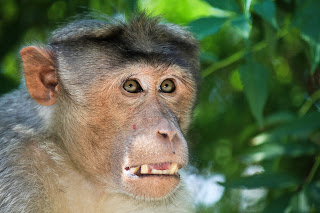
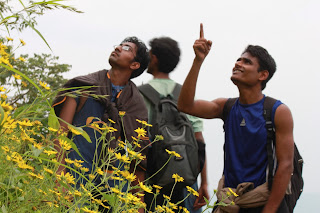


Suddenly as if after a meticulous planning, the whole group of monkeys attacked us. Sangam and I ran pell-mell while Anil and Nisarg were trying to find a way to escape. A monkey jumped on Nisarg’s bag and scattered its contents. Sangam was a little paranoid and was shouting at me to stop running. He was mad at me for leaving them. Nisarg had lost his rain coat, gifted by his father, in the commotion.

 It
resembled a rape scene of typical Indian movie—scattered clothes, bags, bottles…
It was a life time experience for all of us: of getting surrounded by monkeys, sharing
space and time with the scary Alpha male…
It
resembled a rape scene of typical Indian movie—scattered clothes, bags, bottles…
It was a life time experience for all of us: of getting surrounded by monkeys, sharing
space and time with the scary Alpha male…
I
am sure we have all read many stories of valour in our schools. Some of us even
imagine ourselves as the protagonist of the story. Do we really have those
characters in us? Can we imbibe them just by being enclosed in the four walls
of a classroom? May be, if we had stayed together, Nisarg might not have lost
his precious rain coat.
I
realise that treks are not just aimless trudging in the wilderness. They teach
us life lessons. They reveal our inner selves, improve our learnability and
make us mentally strong. Until we are
confronted with unexpected situations, we don’t quite know what we can and what
we can’t. It is in such situations, we learn that life is not linear. But,
isn’t that the beauty of it?
So,
Yatrigan Kripaya dhyan de! What makes
Life worth it is the journey—the people we meet, places we see, things we learn
or unlearn, the joy we find in the simple things… What say, readers? Hellooo!! Anybody there..? Was I that
preachy? J
Feel free to share your views and stories.
PS:
Sitting through a boring lecture was the driving force for writing this article.
After all, anything can be turned useful. Why not a boring lecture?!
Photos: Nisarg P Desai
Subscribe to:
Posts (Atom)